Jiaozi vs khinkali vs pierogi: three dumplings, three arguments
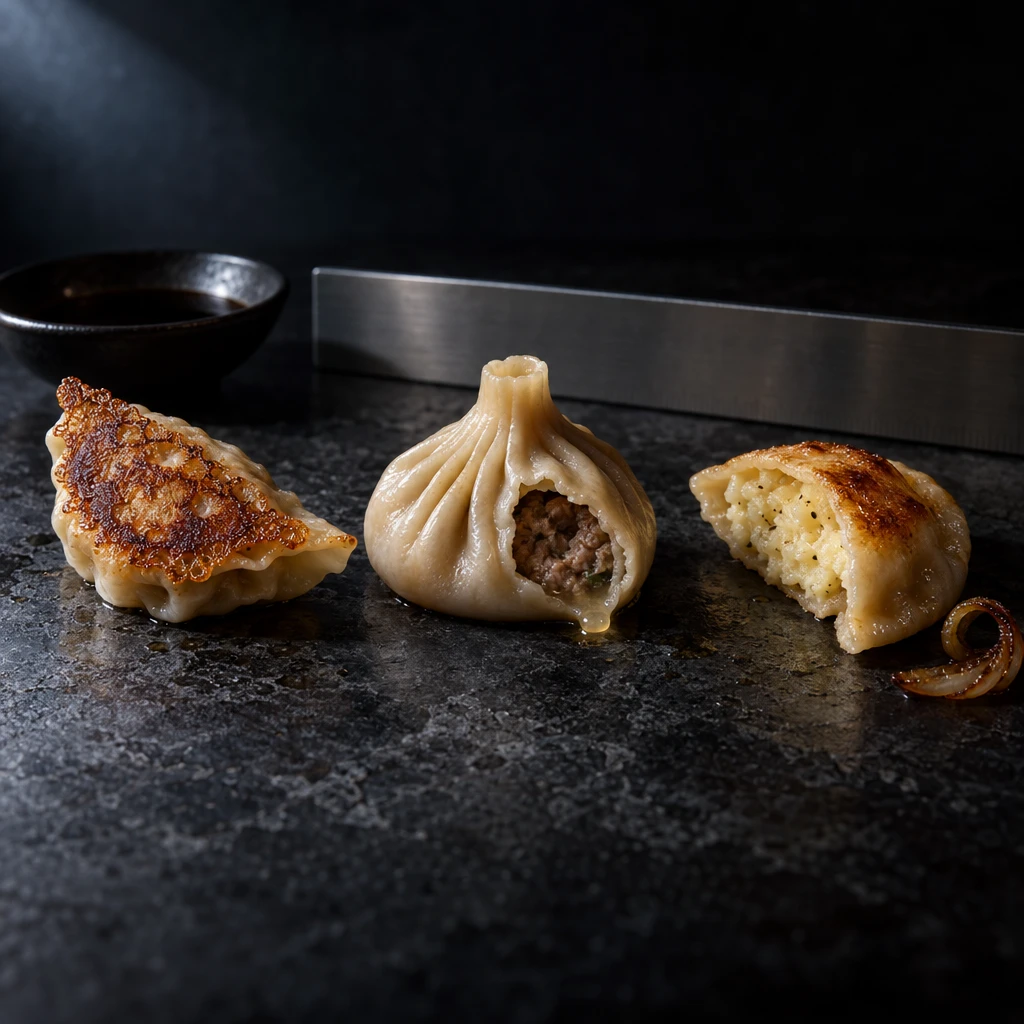
Every food culture with flour and a patch of land figured out the dumpling. Wrap a filling in dough, cook in liquid, eat with your hands. The shape is so universal that people talk about dumplings as one category, which is mostly a mistake. A jiaozi is not a slightly different pierogi. A khinkali is not a bigger jiaozi. These are three different technologies solving three different problems. Here's the argument for each, and when you should actually make which.
Jiaozi: the thin-skin, crisp-bottom one
The Chinese jiaozi is the oldest of the three, with the earliest unearthed jiaozi found in tombs dated 499 to 640 CE. The dough is the whole point. Traditional wrappers are rolled thin, almost translucent at the edges, thicker in the center where the filling sits. The filling is finely minced pork or pork-and-vegetable, seasoned assertively with soy, ginger, chive, sesame oil, because the wrapper is so neutral.
What makes jiaozi technologically distinct is that the same dough and the same fold can be boiled, steamed, or pan-fried into guotie. The pan-fried version, with a lacy brown crust formed by pouring a flour-water slurry in at the end, is the move when you want textural contrast. Pork Chive Jiaozi is the foundational version and the one to learn first. Chicken Momo is the Himalayan cousin, descending from the same lineage via the Silk Road, steamed rather than boiled, finished with a tomato-chili achaar that tells you immediately you have left East Asia.
Make jiaozi when you want a dumpling you dip. The wrapper is a vehicle. The black vinegar is half the dish.
Khinkali: the soup dumpling that isn't a xiaolongbao
Khinkali from the mountainous Georgian regions of Pshavi, Mtiuleti, and Khevsureti solve a different problem entirely. They are not a wrapper-and-filling situation. They are a delivery system for hot broth.
The meat goes in raw, mixed with warm water until the mixture almost sloshes. The dough is thick and sturdy. The twist on top (the k'udi, or tail) is pleated into roughly twenty folds and left as a handle. The dumpling is boiled, and the raw meat releases its juices into the dough pouch as it cooks. You eat it by hand, biting a small hole in the side to sip the broth before tackling the meat. You do not eat the twist.
A fork through a khinkali ruptures the broth. This is why you'll be gently corrected for using one in Tbilisi.
Khinkali is the version to cook first: beef-and-pork, black pepper forward, just salt to finish. Mantu is a useful neighbor on the plate: similar Silk Road DNA, but steamed rather than boiled, finished with yogurt-garlic sauce and a lentil topping that pulls it firmly into Central Asia.
Make khinkali when you want the dumpling to be the event. One at a time, by hand, arguing about whether this batch is juicier than last time.
Pierogi: the comfort carb with the most filling-to-dough ratio
The Polish pierogi is the softest of the three. Unleavened wheat-flour dough, sometimes enriched with egg or sour cream, rolled thicker than a jiaozi wrapper and stamped into circles with a glass. The edges are crimped firmly, often with a fork. Boiled first, then finished in a pan with butter and onions until the skins blister and caramelize.
Pierogi are the only one of the three where the filling is often not meat. Pierogi Ruskie, the canonical Polish variety, is potato and farmer's cheese with browned onion. The dumpling is a soft pillow, the filling is the personality, and the butter is non-negotiable.
The broader Slavic family stays close by. Potato Varenyky are effectively the same object with a different name and regional accent. Pelmeni swing the other direction: smaller, meat-filled, served in broth or with smetana, closer in spirit to jiaozi than to their Polish cousin. The Slavic dumpling map is blurry on purpose.
Make pierogi when the dumpling is dinner and you want comfort more than ritual. These are the ones you freeze a hundred of on a Sunday and eat on Wednesdays when you cannot face cooking.
When to use which
If you want textural contrast and a dipping sauce, jiaozi. Thin skin, bold filling, crispy bottom, vinegar at the table.
If you want the dumpling to be a whole event, khinkali. Thick dough, broth inside, one at a time, no fork.
If you want the most forgiving dumpling to batch-freeze and pan-fry through a hard week, pierogi. Soft dough, heavy filling, butter and onions, zero ceremony.
They are not substitutes. Learn one per season and by next year you'll have a reliable dumpling for every mood.