How the chili conquered the Old World in a hundred years
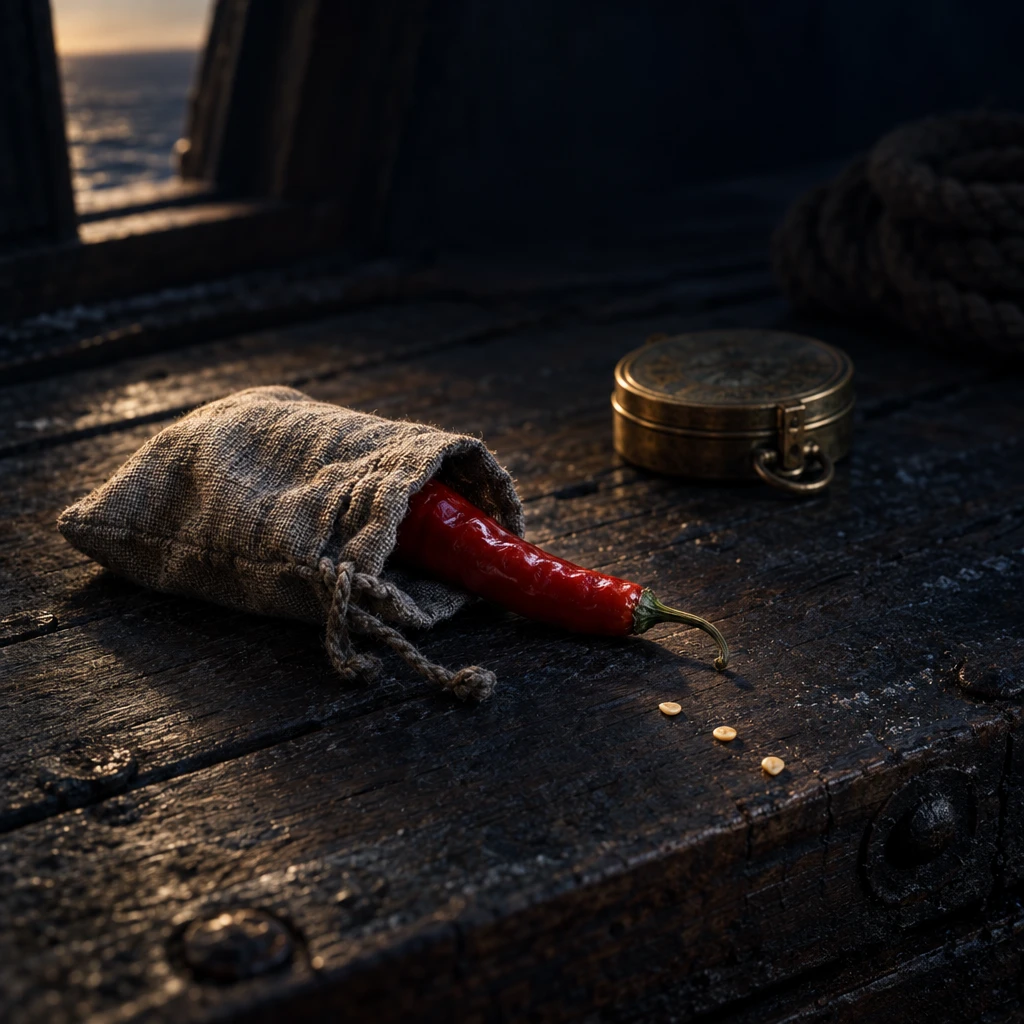
Here is a fact that still surprises people who love spicy food. In 1491, nobody in Asia, Africa, or Europe had ever eaten a chili pepper. Not in a kimchi, not in a curry, not in a mapo tofu. The plant did not exist east of the Atlantic. A hundred and fifty years later it was growing in the gardens of Korean farmers, Bengali cooks, Hungarian paprika makers, and Sichuan peasants, and nobody alive could remember a time when it wasn't.
The chili's arrival in the Old World is one of the fastest, strangest ingredient migrations in culinary history. It is also almost entirely the work of Portuguese sailors, ferrying a New World plant through their trade routes without quite understanding what they had.
Before: the home kitchen
The chili had been domesticated for something like seven thousand years in what is now Mexico, Bolivia, and Peru. When Tenochtitlán fell to Cortés in 1521, it was already the load-bearing flavor of Mesoamerican cooking. The clearest window into that pre-Columbian kitchen is the mole tradition of Puebla and Oaxaca, a sauce that stacks three or four different chilies, each doing a different job.
Mole Poblano is the one to taste if you want to understand what the chili was doing before it left home. Ancho, pasilla, mulato, and chipotle, layered with chocolate, nuts, and seeds into something dark and slow. Everything that follows in this story is a variation on a theme that was already fully worked out on one side of the Atlantic.
The turning point, 1498 to 1542
Columbus brought chili seeds back to Spain in 1493. He called them pepper, which was a marketing choice; the Spanish crown had bankrolled his trips to find an alternative to the black pepper Venice controlled, and something had to be presented as a win. The European aristocracy was not impressed. But Portuguese sea captains saw something the nobles did not. This plant grew everywhere, dried well on a ship, and produced its own heat without the Venetian supply chain.
Vasco da Gama had reached Calicut in 1498. Within a generation, Portuguese ships were running chili seeds between Brazil, the West African coast, Goa, and Macau as casually as ballast. By 1542, three distinct cultivars were growing around Goa, where locals called them Pernambuco pepper after the Brazilian port they had arrived from. In Mozambique, Portuguese sailors bred a wild-growing descendant into what the Ronga people called piri-piri, little-little. You can taste the geography of that trade in Frango Piri Piri, a dish that is Portuguese in method and African in soul.
Asia takes over
India adopted the chili so completely that within a century cooks were writing as if it had always been there. Goa was the hinge. The new American chili was cheaper than long pepper, grew in more places, and layered better with the region's dairy-heavy kitchens. The Kashmiri chili, prized for its deep red color and mild heat, is one of the cultivars that emerged from this period of local selection. A modern bowl of Butter Chicken, lit up by Kashmiri Chili, is unthinkable without that 16th-century handoff.
China got chilies around 1570, probably through Macau or Manila. They sat in coastal gardens for a century as a curiosity. Sichuan province has no documented mention until 1749, which is strange for a place now synonymous with heat. The likely reason: Sichuan was devastated by war in the 1600s and repopulated by Hunanese migrants, who brought the chili with them. It met the native Sichuan peppercorn on arrival and a new grammar was born, the málà of numbing and hot, which today carries every serious plate of Mapo Tofu on earth.
Korea's story is the tightest. Chilies appear in a Korean encyclopedia in 1614, described as a mustard-adjacent spice imported from Japan, itself recently supplied by Portuguese traders. For roughly a century after, Koreans did not know what to do with them. Kimchi as a red, fermented, chili-driven dish is a late-17th and 18th-century invention. The bright red Gochugaru you taste in every modern Kimchi Jjigae is, in the arc of Korean cuisine, a new arrival. Older than your grandmother but younger than Shakespeare.
Today
What is striking, looking back, is how thoroughly each receiving culture absorbed the chili and then forgot it had ever arrived. Ask a Sichuanese chef, a Goan fisherman, a Mozambican cook, or a Korean grandmother where their chili comes from, and most will say from here, obviously. Which is, in its way, correct. A plant that travels five hundred years becomes native. The chili did not so much conquer the Old World as get adopted by it, one kitchen at a time, and then quietly rewrite the recipe book as if it had always held the pen.