Lima: the world's most patient kitchen
Most great food cultures are the product of centuries of stubborn continuity. Peru's is the opposite. Lima's kitchen is what happens when a coastline keeps absorbing newcomers and refusing, politely, to pick a side.
The short version. Spanish colonists brought wheat and beef. West African cooks, enslaved on the coastal plantations, brought the seasoning logic that still runs through the home kitchen. Chinese laborers arrived in 1849 to work the railroads and, by the 1920s, had opened the first chifas in Lima. Japanese migrants landed on the sugar plantations in 1899 and eventually rewrote what a piece of raw fish could look like. Under all of it sits the Andean larder that was already there: three and a half thousand varieties of potato, quinoa, and the chili peppers that do the real heavy lifting.
None of it was planned. All of it got eaten.
The coast, the mountains, the jungle
Peruvians will tell you there is no single Peruvian cuisine, only three. Costa, sierra, selva. Eighty-four of the hundred-and-three recognized life zones on the planet sit inside this one country's borders, which is a polite scientific way of saying the geography is completely unreasonable. A Lima cook can, on the same Tuesday, work with Pacific fish, Andean tubers and Amazonian fruit, and nobody finds this remarkable.
That vertical pantry is why the national dishes feel so unlike each other. Ceviche Clásico is coastal logic distilled: cold Humboldt-current fish, lime, onion, the mineral hit of ají. Papa a la Huancaína is highland logic on a plate, yellow potatoes under a sauce built on ají amarillo and fresh cheese, named for the town of Huancayo at 3,200 meters. The two dishes share a country and almost nothing else, and Peruvians eat both in the same week without comment.
Chifa: the accident that became a national cuisine
The word chifa is a Peruvian mishearing of the Cantonese chī fàn, to eat a meal. The restaurants started appearing in Lima's Barrio Chino in the 1920s, cooked by men who had finished their indenture contracts and stayed. What they made was not Chinese food. It was what happens when a Cantonese wok cook is handed Peruvian beef, Peruvian onions, Peruvian ají and a bottle of soy sauce, and told to feed homesick miners and curious locals at the same table.
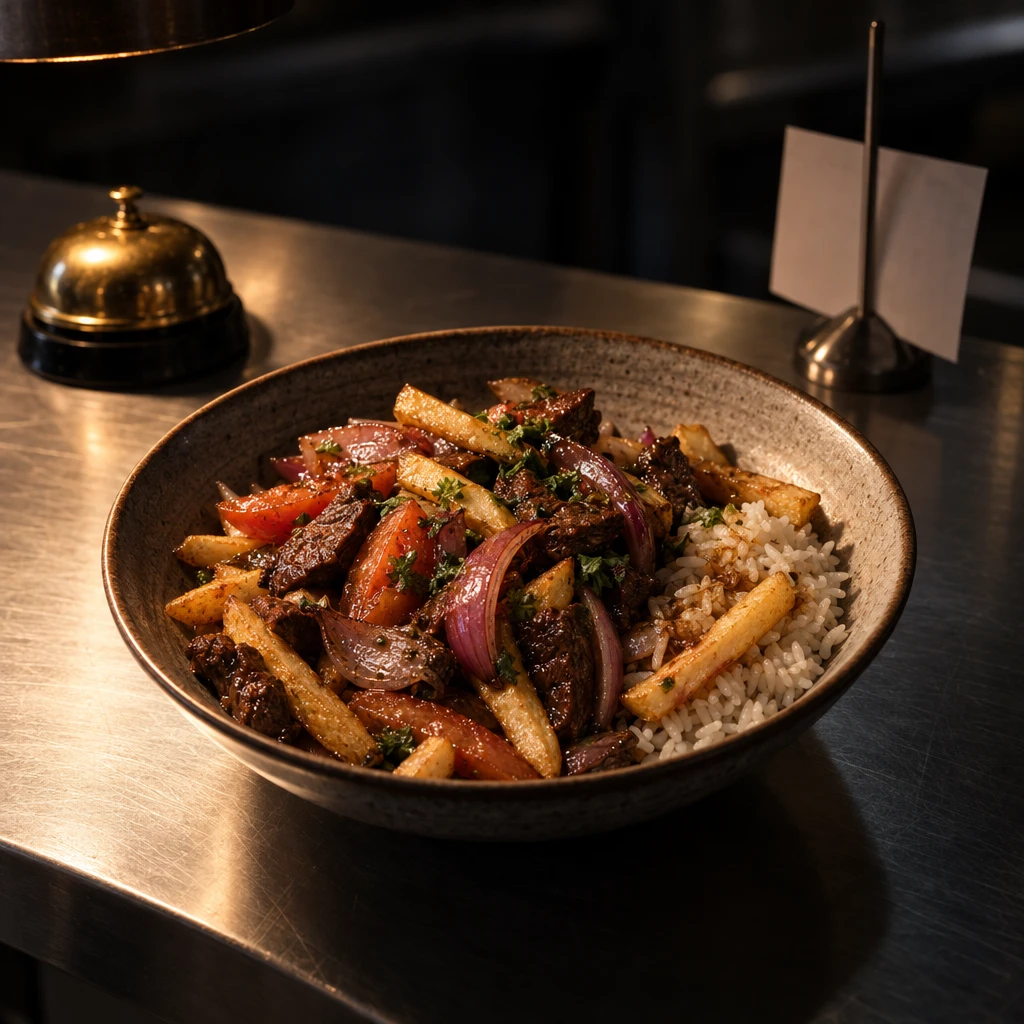
The result is Lomo Saltado, which might be the most honest fusion dish on earth. Beef stir-fried over screaming heat with red onion, tomato, soy, a splash of vinegar, and then, at the last second, tossed with french fries and served over white rice. Two starches. Nobody apologizes. Arroz Chaufa, the chifa fried rice, is the version of fried rice that raised a generation of Peruvian kids and is now more firmly national than anything the Spanish brought over.
Nikkei: the quiet one
If chifa is the boisterous cousin, nikkei is the one that grew up and became famous. Japanese cooks in Lima discovered a coastline fat with fish and a population that had already been eating it raw for a couple of millennia, just differently. What they built, slowly, across four generations, was a grammar: sashimi discipline crossed with ají heat, soy crossed with lime.
Tiradito is the clearest window into it. Sashimi-thin slices of raw fish, no onion, dressed directly with a tiger's milk sharpened with ají amarillo or rocoto. No marinade time, no chew, just the cold shock of the fish and the sauce. Nikkei Ceviche takes the same logic a step further, introducing soy and dashi into the leche de tigre and letting the Andean and the Pacific talk to each other on the plate.
Why it all works
The trick, if there is one, is that nobody at any point tried to preserve anything. The Cantonese cooks did not protect their recipes. The Japanese did not insist on Japanese fish. The Andean cooks did not treat the potato as sacred. Every generation just cooked with what was there and what they missed from home, and over time the two things stopped being separable.
This is why a Lima grandmother can serve Ají De Gallina, a Spanish colonial stew of shredded chicken in a creamy ají-amarillo sauce thickened with bread and walnuts, next to a plate of Causa Limeña, layered yellow potato pressed around tuna and avocado, and consider neither of them fusion. They are just dinner.
A note on shopping
If you want to cook this food at home, almost everything comes down to two jars and a bag of rice. Ají Amarillo Paste is the one non-negotiable; it is the fruity, sunny, mildly spicy backbone of huancaína, ají de gallina, and half of the leche de tigre recipes worth making. A jar of Ají Panca Paste covers the darker, smokier end (anticuchos, lomo saltado marinades). Keep a bag of Limes in the fridge and you are essentially in business.