Osaka, plate by plate: a city that eats itself awake
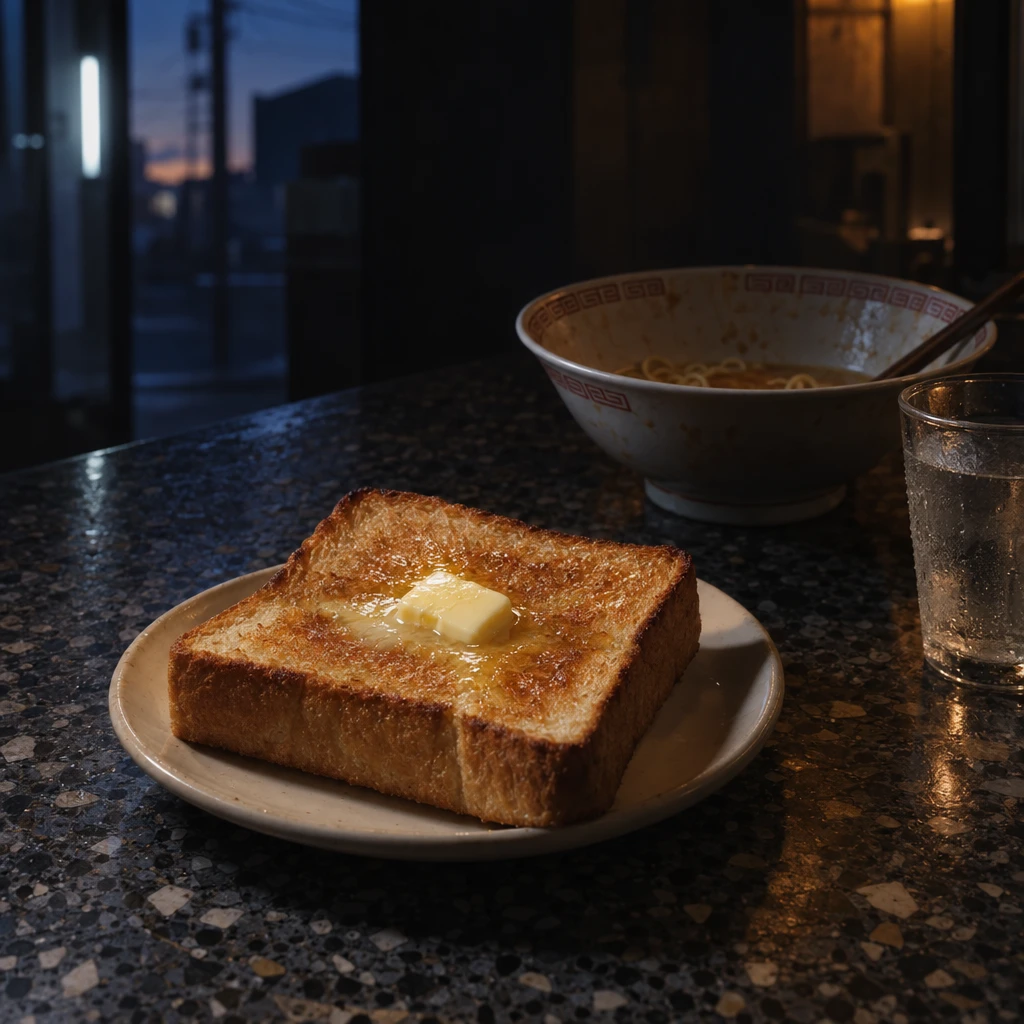
Osaka has a word, kuidaore, repeated so often it sounds like a municipal slogan. It means, roughly, eat until you go broke. Eat until you fall over. What strikes you after a few days is how unironically the city lives it. Tokyo eats to refuel. Kyoto eats with one eye on history. Osaka just eats, from seven in the morning until the last stall closes and the last drunk salaryman finishes a skewer on the walk to the train.
A week of meals follows, mostly cheap, mostly standing up.
Morning, in a kissaten
I had been told about Osaka's morning service but not prepared for how stubbornly it persists. Walk into almost any retro coffee shop, a kissaten, before 11am and for about 600 yen you get a thick slab of white toast, a boiled egg, a tiny salad, and a coffee strong enough to stand a spoon in. Nobody rushes. The regulars read the sports paper. The owner, almost always a woman in her seventies, refills your water without asking.
I kept going back to a place in Tenjinbashisuji, the shopping arcade that stretches three kilometers and swallows you whole. The egg came on a little saucer. The butter came in foil. The absence of ambition was itself a kind of hospitality.
Lunch stands up
By noon, Osaka is already vertical. The city invented tachigui, standing eating, and the udon shops at train stations are the purest version of it. You buy a ticket at a machine, hand it to a man who does not look up, and thirty seconds later a bowl slides across the counter: hot broth, a nest of thick white noodles, a sheet of wilted spinach. Kake Udon at its plainest. You eat it in six minutes. You leave.
The broth is the point. Good dashi is an Osaka obsession, and you can taste the difference between a shop that makes its own and one that does not. At home I have made peace with bottled Dashi Stock, but in Osaka you are reminded how much further the real stuff goes.
The griddle streets
Osakans will tell you, unprompted, that their city invented Okonomiyaki and Takoyaki. The history is debatable on the first and firm on the second. It does not really matter. These are the city's griddle foods and they are everywhere.
In a tiny okonomiyaki place in Fukushima, an older couple cooked in front of us on a teppan built into the counter. She did the batter, a mountain of shredded Cabbage bound with egg and flour, draped with strips of Belly. He did the flipping, once, decisively, with two spatulas. Then came the brown sauce, the mayonnaise, and a flurry of bonito flakes that moved on the heat like something alive. We ate it off the griddle, not the plate.
Takoyaki is the louder cousin. You eat it on the street, eight molten spheres in a paper boat, and you burn the roof of your mouth because you always do. The good stalls, the ones with a line of locals, use a dashi-heavy batter and a piece of octopus you can actually identify.
Night crawls through Tenma
Tenma, north of the river, is where Osakans go after work. Over a thousand bars and restaurants are packed into a grid of lanes that smell, in the best possible way, of charcoal and cheap beer. The yakitori alleys are the heart of it. Yakitori here is not precious. It is two grandfathers in a doorway grilling chicken thigh and leek over binchotan, charging you 150 yen a stick, refilling your glass before you ask.
You order by pointing. Tare or salt. Thigh, skin, liver, the triangle of chicken oyster. Someone at the next table buys you a beer because you looked confused. You buy the next round. The grill master, who has not stopped moving, nods at you for the first time.
Late, under the tarp
Around midnight the ramen queues form. Not strictly an Osaka specialty, but the city has absorbed Tonkotsu Ramen and made it a closing ritual. A good Osaka tonkotsu is thinner than a Hakata one, still that cloudy pork broth that has been simmering since the morning shift came in.
You sit at the counter. Someone behind you is crying at their phone. Someone to your left is working through a beer with the unhurried purpose of a person who does not have to be anywhere. The bowl arrives. You eat it, and walk out into a city that is still, somehow, serving dinner.
That is the Osaka lesson. Not that the food is better, an argument I am not interested in having. That the city has decided, somewhere along the line, that eating is not a means to an end. It is the end. Kuidaore. Tomorrow, thick toast and a boiled egg, and we start again.