Scoop, Split, or Tear? 4 Flatbreads That Change the Whole Dinner
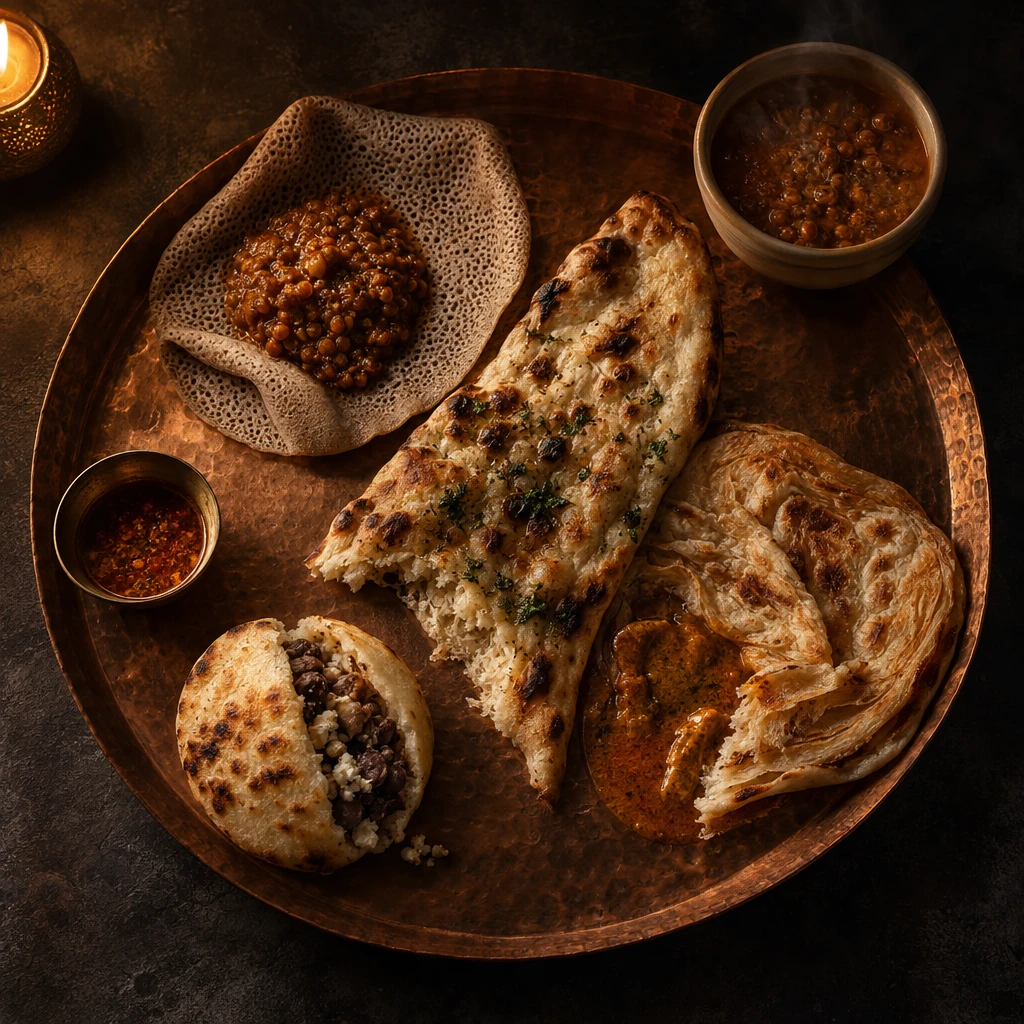
Put four breads on the table and dinner starts making decisions for you.
One wants a spoonable stew. One wants a shallow pool of curry for dragging and folding. One all but asks to be split and packed. One stretches across the meal like a soft placemat, ready to be torn and passed.
That is the useful way to compare flatbreads. Not by asking which is best, but by asking what kind of meal each bread is built to carry. Texture is not a side issue. Texture is the strategy.
The bread that becomes the plate
If the meal is saucy, communal, and happiest when everything touches, Injera has a structural advantage that the others simply do not. Its soft, porous surface, made with the tang and elasticity that come from Teff, does two jobs at once. It absorbs liquid and still gives you enough grip to lift a bite cleanly.
That matters with stews, braises, lentils, or long-cooked vegetables. You are not just placing food on bread. The bread is part plate, part utensil, part final bite. Every scoop picks up sauce, spice, and a little acidity from the fermentation. That last piece is why injera can make a rich meal feel more balanced than heavy.
Side by side with the others, injera is the least interested in neat edges. It is not for stuffing. It is not for shattering into flakes. It is for dinners where the food spreads out and the table slows down.
Use it when: the main dish is loose, spoonable, and meant to be shared rather than portioned.
The bread that lives for the dip
Roti Canai is a different kind of genius. Where injera absorbs, roti canai resists for a moment, thanks to its laminated layers and the richness that often comes from Ghee. That delay is everything. It lets the bread stay crisp and flaky at the edges while the inner layers turn tender where they hit the sauce.
This makes it the best candidate here for dipping into curry, dhal, or any dish where you want contrast in every bite. Tear off a piece, swipe, fold, eat. The pleasure is in the mix of textures: crisp, chewy, slick, soft.
What it does not want is a heavy load. Fill roti canai too aggressively and its delicate layering stops being an asset. It becomes slippery, then messy. Compared with injera, it is less absorbent. Compared with arepas, it is a poor container. Compared with naan e Afghani, it is more about finesse than reach.
Use it when: dinner comes with a bowl or two of sauce and you want the starch to add texture, not just bulk.
The bread that wants to be split and filled
If your meal needs structure, Arepas con Hogao is the clear winner. Built from Cornmeal, an arepa gives you a crisp exterior, a tender center, and, most important, a form that welcomes a filling instead of merely accompanying it.
This is the bread for roast meats, black beans, scrambled eggs, cheese, avocado, shredded chicken. It handles pressure well. You can cut, stuff, and eat it without chasing drips across the plate. Even when topped rather than filled, as with hogao, the arepa behaves like a platform with edges rather than a sheet waiting to tear.
That makes it the most meal-prep-friendly of the four. It travels well. It portions cleanly. It turns leftovers into something that feels planned.
But the same sturdiness gives it limits. Arepas are less graceful with very wet dishes than injera. They do not offer the layered delicacy of roti canai. They are also less naturally social than a large shared naan.
Use it when: dinner needs a vessel, especially for fillings and leftovers that want a home.
The bread that anchors the whole table
Then there is Naan e Afghani, the bread that changes the geometry of dinner. Long, broad, and gently chewy, often built on Bread Flour and Active Dry Yeast, it is made to lie across the center of the meal and invite tearing from every side.
Unlike roti canai, it is not prized for many layers. Unlike injera, it is not meant to act as the plate. Unlike an arepa, it is not trying to become a sandwich. Its gift is scale and steadiness. It can handle kebabs, yogurt, herbs, beans, and braised dishes without disappearing under them.
Naan e Afghani is especially good when dinner has multiple small companions on the table. A bowl of yogurt, a vegetable dish, a little pickle, a meat dish, something brothy, something charred. It lets each diner build a bite without the meal collapsing into either soup or sandwich.
Use it when: you want bread to organize a shared spread and make the table feel like one meal, not several separate plates.
The useful lesson in all four is that starch is never just starch. It decides pace, mess, portion, and even conversation. Choose Injera when the meal wants to mingle. Choose Roti Canai when you want contrast and dip. Choose Arepas con Hogao when dinner needs containment. Choose Naan e Afghani when the table itself is part of the point.
Pick the bread first, and the rest of dinner stops being a list of dishes. It becomes a way of eating.