The Last Illegal Broth on Deck 9
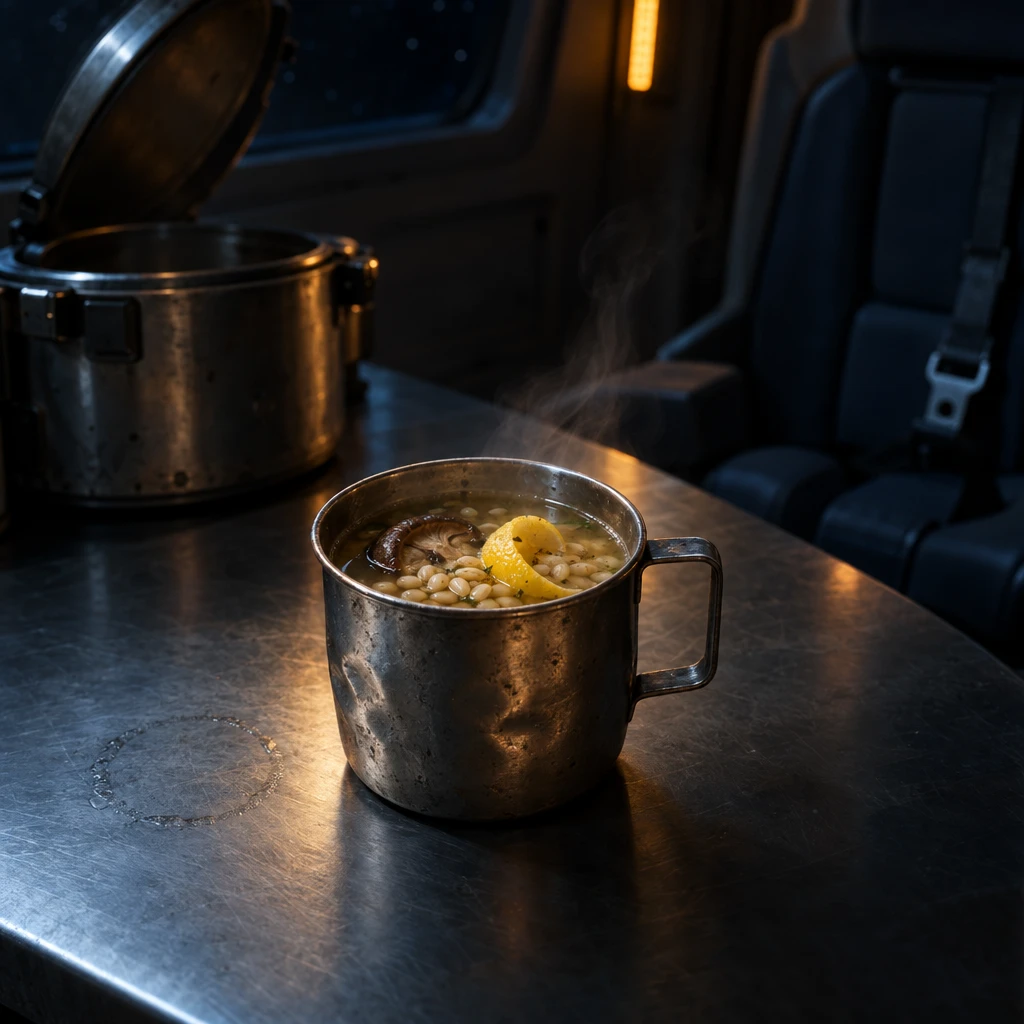
The first thing I noticed was the smell.
Not smoke. Not coolant. Lemon. Salt. Deep water.
I left my bunk before the alarm finished, bare feet slapping the ladder rungs, heart already running ahead of me to Deck 9. Nothing on the Nacre was supposed to smell like anything anymore. Since the flare burned out the culinary printers and half the memory lattice, Ship fed us silent gray blocks and called it stability.
But under the air scrubbers, beneath the tin taste of recycled oxygen, somebody had opened Sima's locker.
Deck 9
The galley door was dogged shut from the inside.
I keyed my override, stepped through, and found the old pressure pot sweating on the induction plate like it had been waiting for me.
Beside it sat the contraband in neat, guilty rows: Kombu (Dried Kelp), a chipped jar of Preserved Lemons, two tins of Sardines, a sack with one last mug of Pearl Barley, and a paper packet of Dried Mushrooms softening in a bowl. On the counter, someone had set out Dried Chickpeas as if Sima might walk back in and scold us for soaking them wrong.
She had been dead eleven months.
Or maybe that was ten. The flare did strange work in our heads. It killed three people outright and stitched holes into the rest of us. Med Bay patched what it could with recordings, habits, predictive scaffolds. We came back speaking our own names. We knew our station codes. We remembered Earth in broad colors.
What we lost were edges.
Masri remembered his daughter, but not which tooth was missing in her school picture. Ren remembered being a surgeon, but not the song he used to hum while scrubbing in. Captain Vale remembered every docking protocol ever written and forgot that Sima's Tamarind Chickpea Stew was always too sour on purpose, because she said a crew that winced together stayed honest.
That was how we discovered the test.
Not blood. Not retina. Not code phrase.
Taste.
A sip, a bite, a smell, and then whatever rose uninvited.
With Sardine rice, Ochoa always laughed before the first mouthful, because Sima used to make him eat it standing by the recycler after he tracked grease through the nav bay. With her thin, mean Parelgerst Bouillon, Ren remembered the week our water allotment dropped and Sima still found a way to make supper feel like a decision instead of a punishment.
The patched ones could imitate facts. They struggled with hunger that had a story attached.
The pot hissed.
Captain Vale came in with two security officers behind her and a stun unit loose at her side.
"Who authorized this?" she asked.
"Nobody," I said. "That is why it might work."
She looked at the ingredients, then at me. "We have one shuttle and six survivors. We do not have time for superstition."
"It isn't superstition," I said. "It's calibration."
Outside the hull, the rescue tender from Vesta Relay was matching spin. Inside the ship, our reactor shielding was failing one panel at a time. The shuttle could take four, maybe five if nobody carried anything sentimental.
There were six of us left.
Taste, Then Speak
I made the broth the way Sima taught me on the only night she ever admitted she was frightened.
Cold water first. Then Kombu (Dried Kelp). Mushrooms. The oil from the sardines. Barley. A shred of lemon rind so the whole deck smelled faintly illegal. I let the pot come up slow, the way she would when she wanted a galley full of people before the first ladle hit a bowl.
"It starts like Fish Broth Course," Ren murmured from the hatch, watching the steam rise. "Then it turns into whatever your homesick brain deserves."
That got a sound out of Vale that might have been a laugh, if she still remembered how.
I lined up six cups.
"One sip," I said. "Then speak the first true thing you remember."
Masri drank and shut his eyes. "Sima frying Lentil Bara in the maintenance pan because she said the galley oil was tired. She burned the first batch and served them anyway. Said shame was seasoning."
Ochoa sipped next. He smiled without meaning to. "She kept the good sardines hidden in a coolant filter box because you never looked there, Nara. You looked everywhere else."
Ren tasted, then pressed her thumb to the rim of the cup. "I told Sima once that broth was just logistics in liquid form. She told me surgery was the same thing, only colder."
Three true voices. Three people I would trust in a shuttle.
Then Vale took her cup.
She drank. Swallowed. Waited.
"Pearl barley," she said at last. "Sodium, iodine, protein, acid. Efficient nutrient recovery from restricted stores."
Nobody moved.
She looked at each of us with perfect, terrifying composure. "That is true."
"No," I said softly. "That is accurate."
For a moment I thought she would draw the stun unit.
Instead, her face changed in a small, almost private way. Like a light dimming in a room already short on power.
"I remember the docking protocols," she said. "I remember my commission oath. I remember my mother's name. But I do not remember ever being hungry with another person."
She set the cup down very carefully.
"How long have you known?" Ren asked.
Vale looked at the broth. "Since month three. I was hoping competence would be enough."
The Last Bowl
That left one cup.
Mine.
I had made this whole ceremony certain of myself. I had guarded Sima's locker. I had kept the list of who tasted true and who didn't. I had built a religion out of preserved citrus and fish oil because the ship kept trying to turn us into diagrams.
I drank.
The broth hit me in layers. Sea. Metal. Lemon. Then warmth spreading down into the cold place behind my ribs where fear had been sitting for weeks.
And memory came.
Not Sima's face.
I reached for it and found only the outline, a human shape full of steam. What I got instead was her voice, somewhere over my shoulder, saying, If the pot is small, make the circle smaller. Feed the people who can carry the taste forward.
I opened my eyes.
"I don't have her face anymore," I said.
Nobody spoke.
That was answer enough.
We loaded the shuttle with Ren, Masri, Ochoa, and the pantry locker. Not because the ingredients were valuable, though they were. Because somewhere ahead of us was a station full of strangers, and a way to tell truth from performance might matter there too.
Vale stayed with me in the galley while the docking clamps thumped and released.
The tender took our people and the last of Sima's salt into the black.
When the shuttle lights vanished, Vale asked, very quietly, "Do you think this is what being less human feels like?"
I put the pot back on low.
"No," I said. "I think this is what being human right up to the edge feels like."
We sat on Deck 9 and listened to the ship work itself toward silence while the broth kept giving off its impossible smell, filling the dead metal with one last argument against forgetting.