The Last Ladle
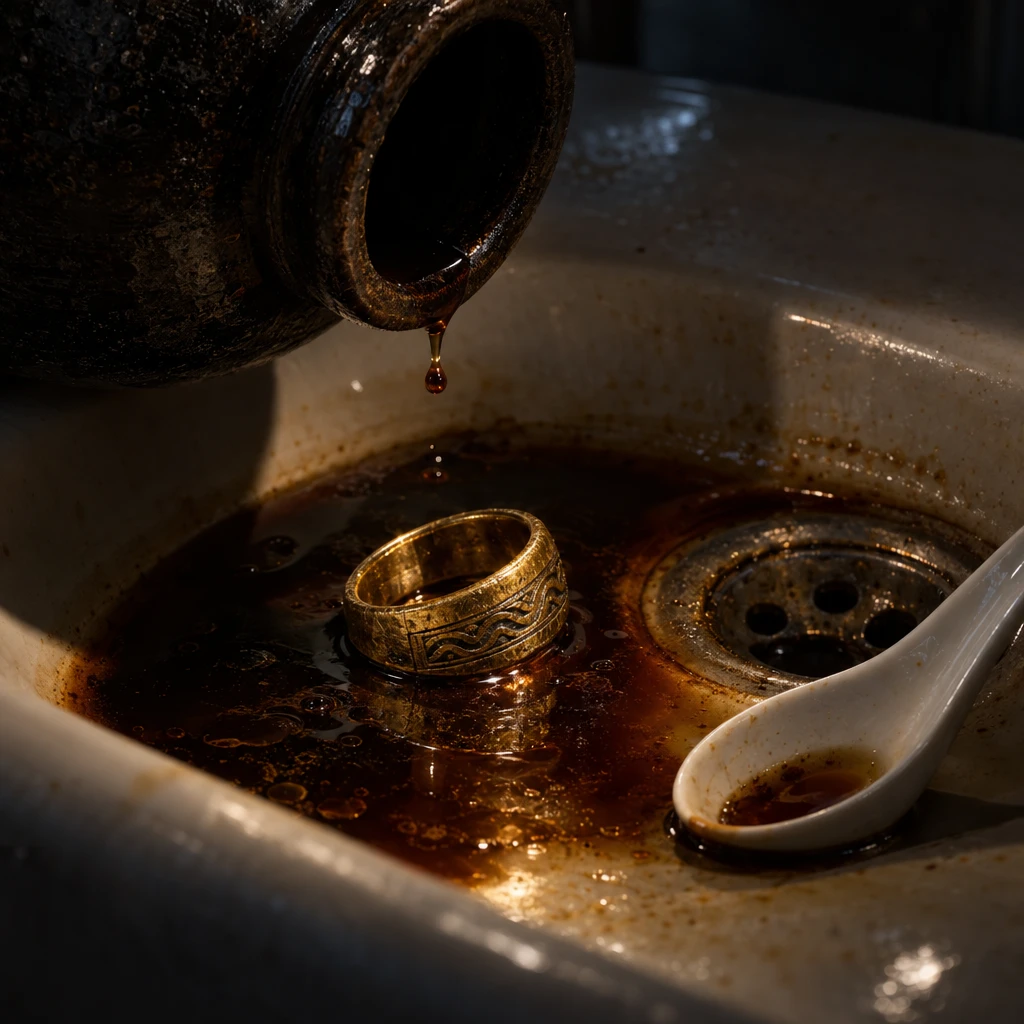
The broth smelled wrong at 12:43 a.m.
Not spoiled. Spoilage was loud, even when it whispered. This was sharper, medicinal, hiding beneath soy, old duck fat, and the sweetness that had lacquered three generations of meat.
Mei dipped the white spoon again.
Her uncle caught her wrist before it reached her mouth.
“Throw it out,” Zhen said.
He had never touched her while she held a spoon. In this kitchen, that counted as panic.
Closing Time
The restaurant had belonged to Mei for eleven days, though every surface still answered to her father. His cleaver notch marked the chopping block. His handwriting covered the freezer tape. His last batch of Fujianese Lu Shui Duck remained on the menu because regulars complained when grief changed dinner.
The master stock was older than the lease, older than Mei. Her grandmother had carried one sealed jar of it when the family moved, then fed it with Shaoxing wine, soy, rock sugar, star anise, and cinnamon until scarcity became abundance. Each night, they boiled it hard, strained it, cooled it in shallow pans, and returned one ladle to the black ceramic jar beneath the altar shelf.
The mother, her father called it.
Tonight’s cooling log said the stock had fallen from 135 degrees to 70 in two hours, then below 41 within six. The neat numbers were in Zhen’s handwriting.
Mei checked the thermometer history.
There had been no reading between 10:16 p.m. and midnight.
“You filled this in afterward.”
“So did your father.”
“My father is dead.”
Zhen looked at the black jar. “That does not make him honest.”
Mei lifted the lid. A chemical sting rose from the dark surface.
Sanitizer.
Someone had poured it in carefully, not enough to foam, only enough to condemn everything it touched.
“Throw it out,” Zhen repeated.
Outside, rain rattled the exhaust vent. Mei slid the bolt on the back door.
“No.”
The Black Line
They had one rule about the mother jar: never scrape the bottom.
As a child, Mei imagined dragons sleeping beneath the broth. Later, her father explained that old spices, proteins, and char collected there. Disturb the sediment and bitterness rose.
Now she carried the jar to the prep sink and poured.
Zhen moved between her and the drain.
“You cannot save it.”
“I’m not trying to.”
The last liquid came slowly, thick as varnish. Mei tipped the jar farther. Something struck the steel sink with a small, bright sound.
A ring spun once and fell flat.
It was broad, gold, and blackened in the engraved grooves. Mei rinsed it. Inside were two initials and a date.
W.L. 6-14-98.
Wei Lin had washed dishes for her grandmother. Family lore said he stole a week’s receipts and disappeared. Mei remembered his photograph from an old staff party, his arm around Zhen, both young men holding a platter of Lu Shui Egg Tofu.
She also remembered the story’s unnecessary detail: Wei had left his wife.
People added details when the truth was too small to stand alone.
Zhen sat on an upturned bucket.
“It was an accident,” he said.
Mei did not ask what was.
Her eyes had found the shelf of cooling logs. Her father kept everything, even records no inspector could request. She pulled the 1998 binder. On June 14, the stock had supposedly cooled from 140 to 38 degrees in forty minutes.
Impossible.
The next morning’s entry listed a double batch of Fujian braised pork belly for a banquet that had never appeared in the reservation book.
Mei turned the page. A dark thumbprint stained the margin.
“Grandmother found him taking cash,” Zhen said. “He grabbed her. I hit him with the stockpot lid.”
“And then?”
“Your father helped.”
The black jar waited in the sink, empty for the first time in Mei’s life.
“They cut him up?” she asked.
Zhen began to cry.
That was answer enough.
One Ladle Forward
At dawn, Mei set a bowl before her uncle.
Two eggs, braised the previous afternoon, sat in clean broth from the backup pot. Their whites had darkened to the color of old wood.
“Eat,” she said.
He stared at the bowl. “You called the police?”
Mei placed her phone beside him, its recorder lit red.
“I called Wei Lin’s daughter.”
Zhen’s face collapsed. Behind him, the dining room brightened window by window.
He spoke for nineteen minutes. About the lid. The cleaver. The banquet pot. Her grandmother insisting that waste was a second sin. Her father falsifying the log while the stock boiled.
When he finished, Mei took the black jar outside. She expected grief when she dropped it into the dumpster.
Instead, she felt the lightness of ending a ritual.
That evening, she began a new stock in a stainless-steel pot. She wrote every temperature down herself. At closing, she tasted it.
Young, thin, honest.
Still, beneath the star anise and cinnamon, she thought she detected something metallic.
Mei looked at the clean ladle in her hand.
Then she poured the broth down the drain.