Fold, Coil, Roll: Lamination Beyond Croissants
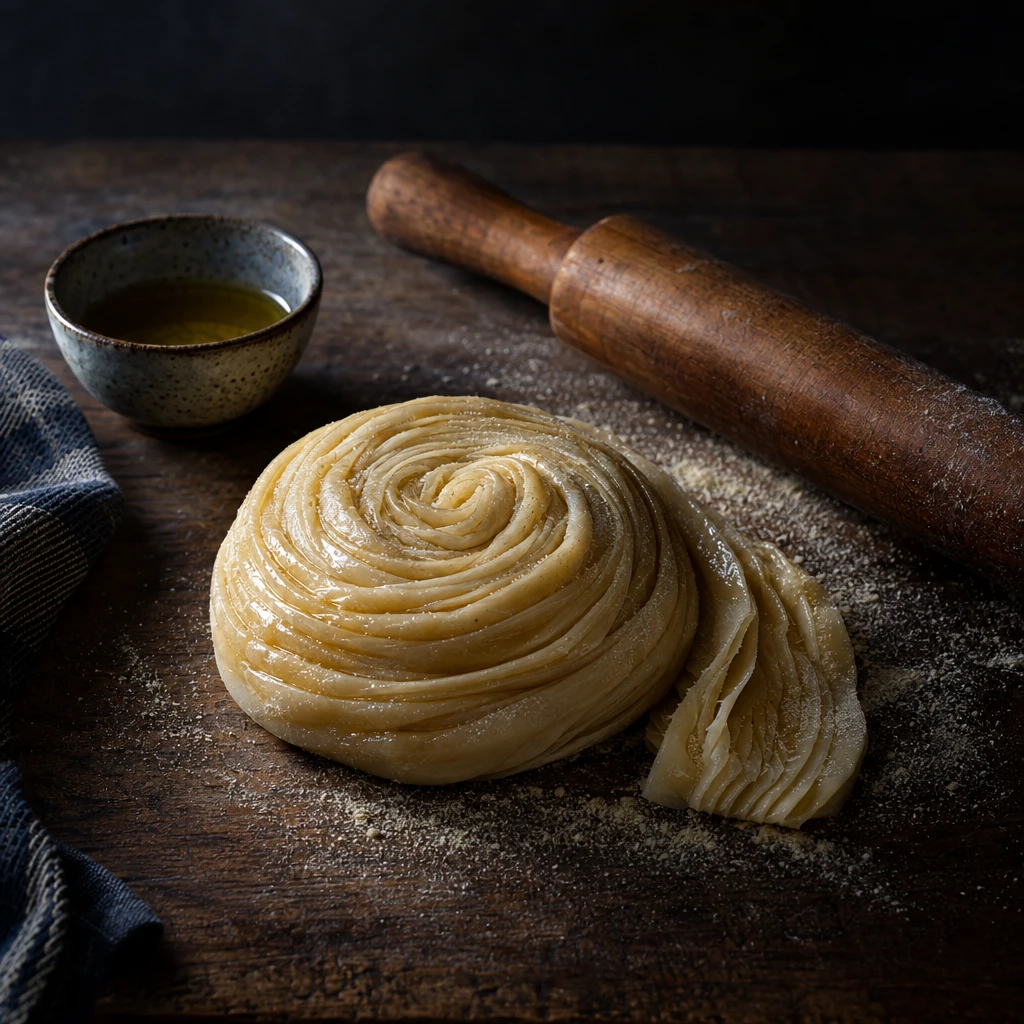
A piece of dough does not need a marble slab, a ruler, or a cold butter block to teach you lamination. It just needs a little fat, a little patience, and a counter you do not mind dusting twice.
That is the useful surprise of layered flatbreads. The lesson arrives without pastry-school ceremony. Stretch a dough thin, slick it with oil or Ghee, fold it over itself, maybe coil it, maybe flatten it again, and suddenly the cooked bread tears into ribbons instead of crumbs. The logic is the same one that makes croissants shatter, but here it feels closer to the stove, closer to dinner, and much more forgiving.
What lamination actually does
Lamination sounds technical because we usually reserve the word for French pastry. But the underlying idea is simple: you are creating alternating sheets of dough and fat so steam can separate them during cooking.
In flatbreads, that separation is usually quick and improvised rather than exact. You are not trying to build dozens of mathematically even layers. You are trying to distribute fat well enough that the dough cannot bake back into a single solid sheet.
That is why recipes like Msemen and Lachha Paratha are such good teachers. They make the concept visible. You stretch the dough until it looks almost too thin to survive, then fold it into a packet or pleat it into a rope. Each move stacks dough onto dough with a film of fat in between. When the bread hits the pan, those stacked planes puff, separate, and turn tender at the seams.
A few practical truths help:
- Thin matters more than perfect shape. If the dough is thin before folding, the layers stay distinct.
- Fat should coat, not flood. Too little and the layers fuse. Too much and the dough slides around and fries before it flakes.
- Resting is structural. If the dough resists rolling, let it sit. Tight gluten crushes layers by snapping back.
Fold, coil, roll
Different breads arrive at flakiness through different motions, but most of them can be understood through three verbs.
Fold is the most direct route. In Msemen, a stretched sheet is folded inward into a square, often with a bit of semolina or fat to keep those folds separate. The square shape is not just aesthetic. It creates corners, edges, and stacked surfaces that cook at slightly different rates, which is why the bread can feel crisp on the outside and almost creamy within.
Coil creates concentric layering. Think of Roti Canai or the beautifully striated structure of Lachha Paratha. A long pleated strip or thin sheet gets wound into a spiral, rested, then rolled flat again. Coiling solves a home-cook problem: it builds many layers fast without demanding exact folding. It also gives the final bread that satisfying pull-apart quality, where the crumb opens like a spool.
Roll is the finishing move that decides whether your layers survive. Too much pressure and you compress the air out of the dough and weld the sheets together. Too timid and the bread stays thick and leathery. The trick is even pressure from the center outward, enough to widen the coil or packet while leaving its internal architecture intact.
That same logic appears in other traditions. Shao Bing uses layered dough to create a crackly, structured interior beneath a seeded crust, often with Sesame Seeds or Nigella Seed adding texture on top. Malawach takes a softer route, with tender, rich layers that separate in broad sheets rather than fine shards. None of these breads behave exactly alike, and that is the point. Lamination is not a single look. It is a method for deciding what kind of flake you want.
How to read the bread in the pan
The pan tells you whether your layering worked.
If the surface blisters quickly but the interior stays dense, the dough was probably too thick when folded or too aggressively rolled at the end. If the bread turns greasy before it browns, the fat layer was too heavy. If the whole thing bakes up flat and bready, the layers likely dried out or fused.
Successful quick lamination gives a few clear signals:
- the bread puffs in uneven pockets rather than one giant balloon
- browned spots appear on ridges and edges first
- when pressed, the surface feels crisp but not rigid
- after cooking, a gentle crush between your palms loosens visible layers
That last move matters, especially with coiled breads. Many cooks lightly clap or scrunch the hot bread to separate the strata. It is not a gimmick. It finishes the texture.
A pastry lesson that belongs to dinner
What makes these flatbreads such good teachers is that they replace precision with sensation. You learn lamination by feel: how thin a sheet can go, how lightly fat should glisten, how a rested coil relaxes under the pin, how a cooked bread sounds when its layers have dried just enough to whisper apart.
Croissants can make lamination seem like a guarded craft. Flatbreads bring it back to the hand. Fold, coil, roll, cook. Then tear one open and look closely. The lesson is right there in the layers, warm enough to eat.