The Tree Resin That Makes Dessert Chew Back
A few ivory-colored tears hit the mortar and shatter like hard candy. Then the pestle warms them, and the fragments begin to resist. Their scent rises slowly: pine forest, citrus peel, fresh wood, something faintly medicinal. Grind too long and the powder turns sticky.
This is mastiha, the aromatic resin that can make a dessert taste brighter, stranger, and more alive. It can also change how that dessert moves across the spoon.
A Resin Rooted in Chios
chios_mastiha comes from the mastic tree, Pistacia lentiscus var. chia. Growers on the Greek island of Chios make careful incisions in the bark, allowing resin to bead and harden into translucent “tears.” The island’s cultivation knowledge was added to UNESCO’s intangible cultural heritage list in 2014.
Mastiha is often introduced as a flavoring, but that description is incomplete. Its resinous compounds also provide body, cling, and, at sufficient concentration, a subtle gumminess. This dual identity explains why it appears in preparations as different as cake, milk pudding, ice cream, and the dense spoon sweet known as ypovrychio.
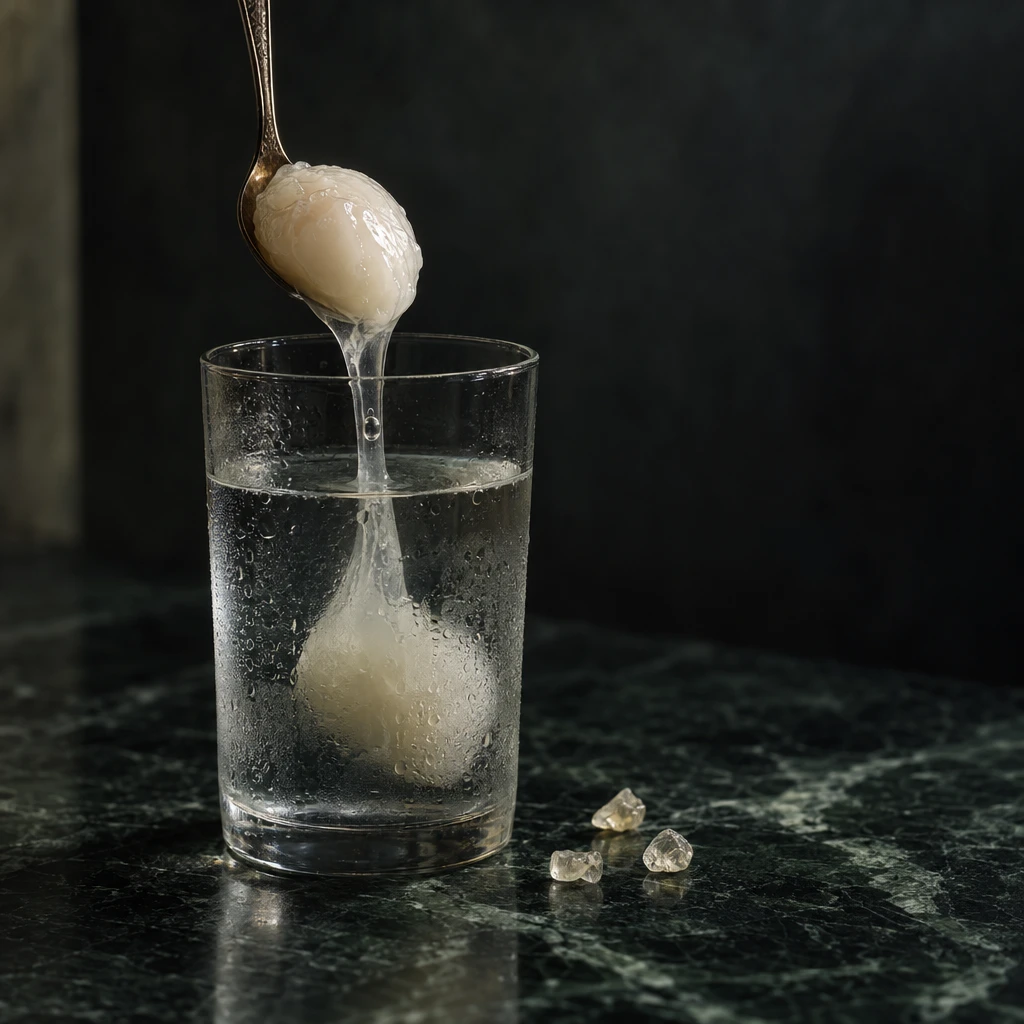
The latter shows mastiha at its most tactile. In Mastic Submarine, a spoonful of the pale, chewy confection is plunged into a glass of cold water. Its name means “submarine.” You eat it slowly from the spoon, taking sips of chilled water between bites as the sweet softens but never quite surrenders its pull.
How to Handle the Tears
Mastiha rewards restraint. One tear too many can push its fragrance from forest-like to aggressively medicinal, especially in mild dairy desserts.
For even distribution, grind the tears with a spoonful of Granulated Sugar taken from the recipe. The sugar crystals help break up the brittle resin and keep it from clumping. A mortar and pestle offers the most control, though a small spice grinder also works.
A few rules make the process easier:
- Keep it cool. Warm resin softens and smears. Chill the tears briefly before grinding, and pulse rather than running a grinder continuously.
- Start with the recipe’s quantity. If improvising, begin with only two or three small tears for a liter of dairy. Tear sizes and potency vary.
- Add it with dry ingredients. Mixing the powder into sugar or starch helps disperse it before liquid is introduced.
- Store it airtight. Keep the tears in a cool, dark place, away from strong-smelling spices.
Mastiha should not dominate every sweet it enters. In Lemon mastic cake, Lemons provide the immediate brightness while the resin extends the citrus aroma into something woodier and more persistent. Cake also makes an important point: mastiha can season a dessert without making it conspicuously chewy.
What Makes Kaimaki Stretch
Mastiha is frequently credited with the elastic pull of kaimaki, the Turkish-style ice cream that bends before it melts. That is only part of the story.
Traditional kaimaki also relies on salep_powder, made from ground orchid tubers. Salep is rich in glucomannan, a hydrocolloid that binds water and supplies much of the ice cream’s characteristic density and stretch. Mastiha contributes its aroma and can reinforce the body, but it does not simply replace salep.
That distinction matters in Kaimaki with Pistachio. The salep builds the resilient frozen structure; mastiha sharpens the flavor and adds a resinous finish beneath the Pistachios. Treating the two ingredients as interchangeable produces either a perfumed ice cream without the expected pull or a stretchy one missing kaimaki’s identifying fragrance.
The same division of labor appears in Mastic Pudding. Here, whole milk becomes spoonable primarily through starch, often Cornstarch. Mastiha supplies perfume and a delicate elasticity, but the pudding’s fundamental set comes from the thickener. Its texture should feel supple, not rubbery.
That is the useful way to understand mastiha: not as a magical stabilizer or an exotic extract, but as a precise ingredient working on two levels. It leaves a trace in the air before the spoon reaches your mouth, then leaves another in the way the dessert yields. Used carefully, the resin does not shout. It makes the sweet answer back.